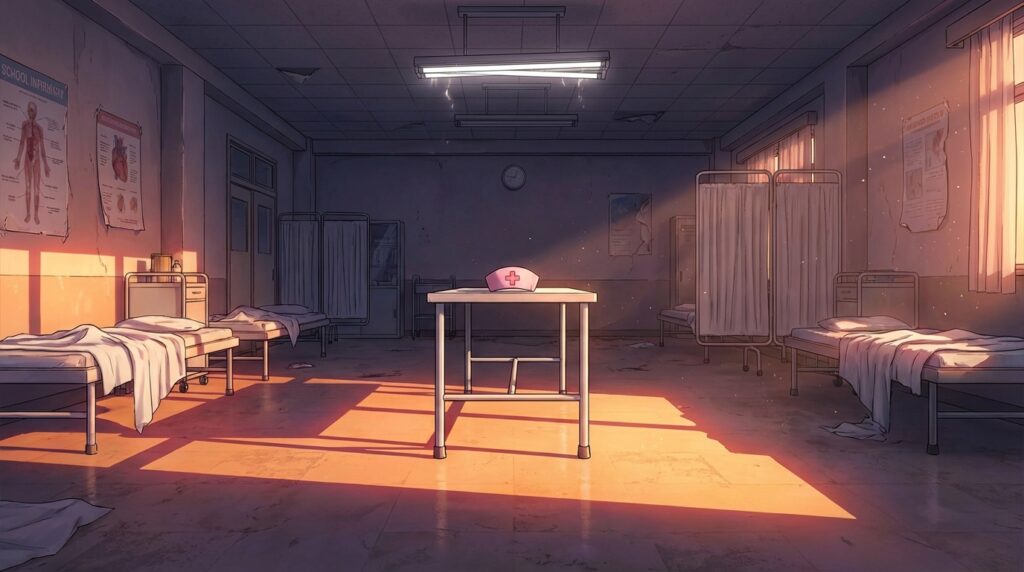
The presence of a substitute nurse in a high school environment should, under normal circumstances, be a triviality. However, Muja Kina represents a unique disruption to the social ecosystem of Akademi. She arrives during the sixth week of the term, filling a temporary vacancy, yet her impact on the student body—specifically Taro Yamada—is disproportionate to her official status. Her psychological profile is characterized by a profound lack of spatial awareness and a personality that borders on infantile, a combination that makes her both endearing to the gullible and a significant nuisance to those with more refined objectives.
The Facade of Clumsiness
Muja Kina’s primary trait is her staggering lack of coordination. While most would view her frequent stumbles and accidental drops as a harmless character flaw, it serves as a powerful social tool. This perceived helplessness triggers a protective instinct in those around her. In the case of Taro Yamada, her “accidental” nature creates frequent opportunities for physical proximity and emotional bonding under the guise of medical care or simple assistance. She is a woman who thrives on being rescued, and Taro is a boy who finds comfort in being the rescuer.

A Nurturing Threat
The relationship between the substitute nurse and the student is predicated on a power imbalance that she seems blissfully—or perhaps calculatedly—unaware of. When Taro seeks refuge in the infirmary, he is not just seeking a cure for a headache; he is seeking a sanctuary from the complexities of his daily life. Muja provides a soft, uncritical presence that requires nothing from him but his company. To an observer, their interactions appear innocent, but the trajectory is clear: if left unchecked, the bond formed in the quiet of the nurse’s office will solidify into something that cannot be easily severed by schoolyard rumors.

Strategic Evaluation and Obstacles
From a tactical perspective, Muja Kina is classified as a Medium-level obstacle. Her threat does not stem from intellect or social standing, but from her environment. The infirmary is a high-traffic area, and as a member of the faculty, her movements are protected by the weight of school authority. Eliminating her requires a higher degree of precision than a standard student rival. Any direct confrontation carries the risk of immediate faculty intervention, making indirect methods—such as framing her for professional misconduct or arranging a fatal “accident” that mirrors her own clumsiness—far more viable for a discreet operative.
Furthermore, her role differs significantly from the rivals of the 1980s or the more aggressive students of the current era. She does not seek conflict; she attracts it through her mere existence. She is a vacuum of common sense that draws others into her orbit, creating a protective shield of witnesses and admirers that must be systematically dismantled.
Thematic Significance
In the broader narrative of Akademi, Muja Kina serves as a reminder that danger does not always wear a mask of malice. Sometimes, the greatest threat to a carefully laid plan is the person who is too foolish to realize they are in the way. She represents the “pure” archetype, an individual whose lack of guile makes them difficult to manipulate through traditional social sabotage. To remove her, one must not target her reputation, but her very presence within the school’s walls.