Hello!
Recently, I posted about how dozens of Yandere Simulator YouTube channels were terminated by YouTube for allegedly violating the rule against supporting “Violent Criminal Organizations.”
This was baffling to everyone, since it wasn’t clear how footage of Yandere Simulator gameplay could possibly be interpreted as supporting a violent criminal organization.
I’ve been working together with a YouTube Partner Manager to provide the Policy Team with lists of Yandere Simulator YouTube channels that appear to have been terminated in error. To date, 60 of these channels have been restored. (If your channel hasn’t been restored yet, please be patient.)
The Policy Team is notorious for not directly engaging in conversations with creators, and only communicating by quoting the community guidelines. However, after repeatedly challenging the Policy Team’s decision to remove a specific video that seemed harmless, we finally managed to get a response that contains meaningful information.
If you’re interested, click Continue Reading.
The Policy Team’s response contains the term “EDSA”, and many people might not know what that acronym means, so I’ll provide the definition here.
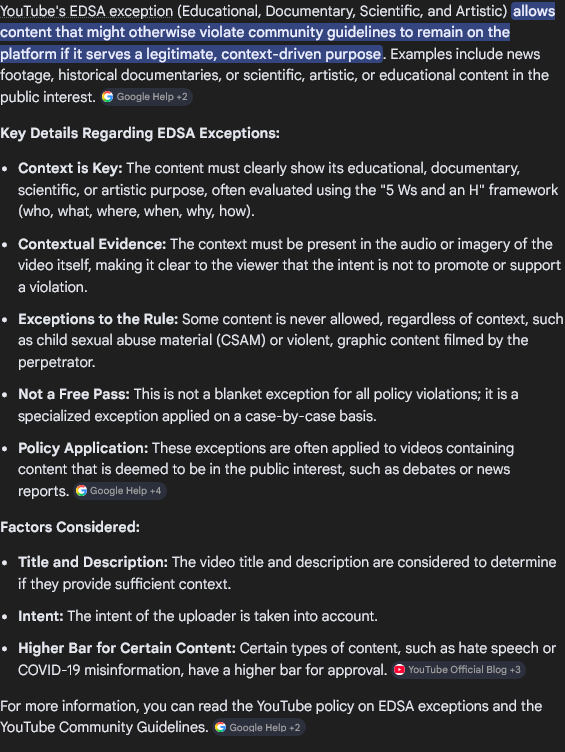
In short, an “EDSA exception” means “Your video technically violates our rules, but we’re not going to take action, because there’s a valid reason to permit your video to remain.”
Example: You can’t upload pornography to YouTube. However, you could upload an educational video explaining how human sexual reproduction works biologically. Displaying medical diagrams of reproductive organs is different from just showing straight-up porn.
Okay – with that out of the way, this is their response, verbatim:
“We assess whether content gets an EDSA exception on a case-by-case basis. First, we check if there’s a Community Guidelines violation in the content. If there’s a violation, we review if there’s enough context in the content to make an EDSA exception. We review WHAT context is present and WHERE the context is. We make most EDSA exceptions when content has one or more of the following:
- Basic facts about what’s happening in the content: Identify who’s in the content, describe what the content shows or when and where it takes place, or explain why certain content is present.
- Condemnation, opposing views, or satire: Communicate that your content condemns certain claims, includes opposing points of view, or is satirical.
- Discouragement of dangerous behavior: Tell viewers not to imitate what’s in the video.
When in doubt, include different types of context described above: basic factual information that explains what’s in your content, multiple points of view, and clear and informative discouragement against imitating dangerous or harmful behavior. For content that risks the most harm, we require context in the VIDEO or AUDIO. Content where we require context in the audio or video to give an EDSA exception includes content related to hate speech, violent criminal organizations, child safety, suicide and self-harm, and graphic violence.”
As usual, the Policy Team did not communicate in plain speech, and simply quoted the community guidelines. However, their decision to quote this specific part of the community guidelines could be the most meaningful thing we’ve heard from them thus far.
Pewdiepie’s Yandere Simulator videos featured footage of students being slaughtered in a school environment. Technically, you could describe his videos as “Content that glorifies or promotes violent tragedies, such as school shootings” – that’s against YouTube’s community guidelines! So, why is he not being punished for that? It’s because his videos qualify for an EDSA exception. There was “enough context” for a reasonable person to watch the video and understand that the video was not encouraging dangerous behavior; there was enough context to conclude that the video was humorously demonstrating the features of a video game.
The Policy Team didn’t outright say, “If you want your Yandere Simulator videos to remain up on YouTube, here’s what you have to do…” but their numbered list may as well function as a checklist of what you have to do in order to qualify for an EDSA exception.
- Identify who’s in the content, describe what the content shows or when and where it takes place, or explain why certain content is present.
- Communicate that your content condemns certain claims, includes opposing points of view, or is satirical.
- Tell viewers not to imitate what’s in the video.
Let’s be real, the third one is the only one that really matters – and I think the Policy Team put the words “VIDEO or AUDIO” in capital bold letters for a reason:
They want us to put a disclaimer at the beginning of the video communicating that viewers should not imitate what’s in the video.
If you’re planning to upload some Yandere Simulator gameplay footage in the near future, I highly recommend putting a disclaimer at the beginning of your video saying something along the lines of:
- This video features fictional characters aged 18 or older dying in a school environment. The purpose of this footage is to demonstrate the mechanics of a video game, NOT to encourage similar behavior in real life.
- The owner of this channel CONDEMNS all real-life violence.
- Under NO CIRCUMSTANCES should you ever imitate any of the violent behavior featured in this video.
Just to be safe, I’d read these words out loud. If you’re not comfortable putting your own voice out there…here, use mine:
I’ll save you the step of Googling “How To Download A YouTube Video” and just provide you with a link:
https://www.mediafire.com/file/cu6vanmfbbob5mi/Disclaimer.mp4/file
Will this be enough to prevent the Policy Team from taking action against your video? I don’t know. We’ll need someone to give it a try. Play Yandere Simulator, record footage of yourself killing someone, slap this disclaimer at the front of the video, upload it, and see what happens.
If it works, great! If it doesn’t work…well, I’ll have to bug the Partner Manager to bug the Policy Team, and then they’ll respond by quoting some part of the community guidelines, and then we’ll have to try and read their minds and figure out exactly what they want from us.
God, this would all be so much easier if they would just communicate like normal people. At this point, it feels like reading tea leaves, interpreting the stars, or using tarot cards would give us a better chance of understanding what the Policy Team wants from us.